
Skoll | Launching the Centre For Exponential Change: A support network for system orchestrators

By Rohini Nilekani (Chairperson, Rohini Nilekani Philanthropies) & Donald Gips (CEO, Skoll Foundation)

If you happen to drive along the highway connecting Guwahati and Shillong in the Northeast of India, you may want to stop at a few of the 350 rural Primary Healthcare Centres (PHCs) and interact with the healthcare professionals. These centres are a thriving testament to the systemic transformation in progress.

Nurse Joyce would explain how she can ensure proper maternal care of the most vulnerable rural women because she has access to uninterrupted power and functional medical facilities such as baby warmers. This is no accident; it’s a thoughtful system orchestration by SELCO Foundation, a 2018 Skoll Awardee and co-traveller with Centre For Exponential Change.

Bringing together state government resources with private players to ensure reliable operations, maintenance, and building capacity of primary healthcare staff is no easy task. Systemic change is underway to make PHCs and other crucial health service points no longer just functional, but resilient and self-reliant. Isn’t it remarkable that such a model of exponential change is emerging as a blueprint for 50,000 rural PHCs across India?

Human history is peppered with long periods of small changes that were disrupted by compounding big shifts. We are living through such a transition, where both our problems and our ability to respond are multiplying at an unprecedented pace. This moment compels us to pause, reflect, and reimagine our response to social problems with exponential thinking. Would linear solutions that may have worked in the past be adequate for the future?

How can we learn from exponential thinking and action in progress? Most successful social innovations scale because of the collective work of many problem solvers across communities, civil society, government, and private sector (Samaaj, Sarkar, Bazaar). One example is the global financing and professionalization of frontline Community Health Workers (CHWs), the backbone of community health services in many countries. A more professionalized workforce active hand-in-hand across communities, civil society, government, and business, is key to responding to public health outbreaks and developing strong health systems.

But much more investment is needed to unlock the full potential of CHWs and to ensure communities have access to professionalized, trained, compensated, and integrated CHWs. Within the Skoll community, we see locally-based partnerships and coordination successfully happening with multiple governments to develop national community health strategies and financing pathways. The Africa Frontline First Catalytic Fund is an example that has already secured $100 million in funding as it seeks to scale-up and sustain 200K professional CHWs across 10 countries by 2030, expanding healthcare coverage to 100M people. But this work takes a specific profile of innovator to build, coordinate, and activate this type of exponential change over time.

What type of innovator does it take to catalyze such exponential change? This requires system orchestration: connecting the dots, fostering partnerships, and driving whole ecosystems forward. Working behind the scenes, system orchestrators bring about transformational social change by knitting together key actors, providing resources and digital infrastructure, and mobilizing collective change efforts. They shape a new paradigm, leverage systems’ resources, navigate complexity and persist with authenticity to create impact at societal scale.

When system orchestrators are networked and resourced, they are able to “conduct” social change symphonies that trigger positive domino effects of change. While not always at the center, or even out front, their coordinating and activating capabilities are critical.

System orchestrators exist and have existed for years. They continue to do influential work behind the scenes that often does not get the public spotlight. By no means is this journey of system orchestrators an easy one. These endeavors are very complex, extend over long periods of time, and bridge many chasms on the way. Does it not behoove us to do our best to unlock their imagination, reinforce their capabilities, and reduce the friction they face?
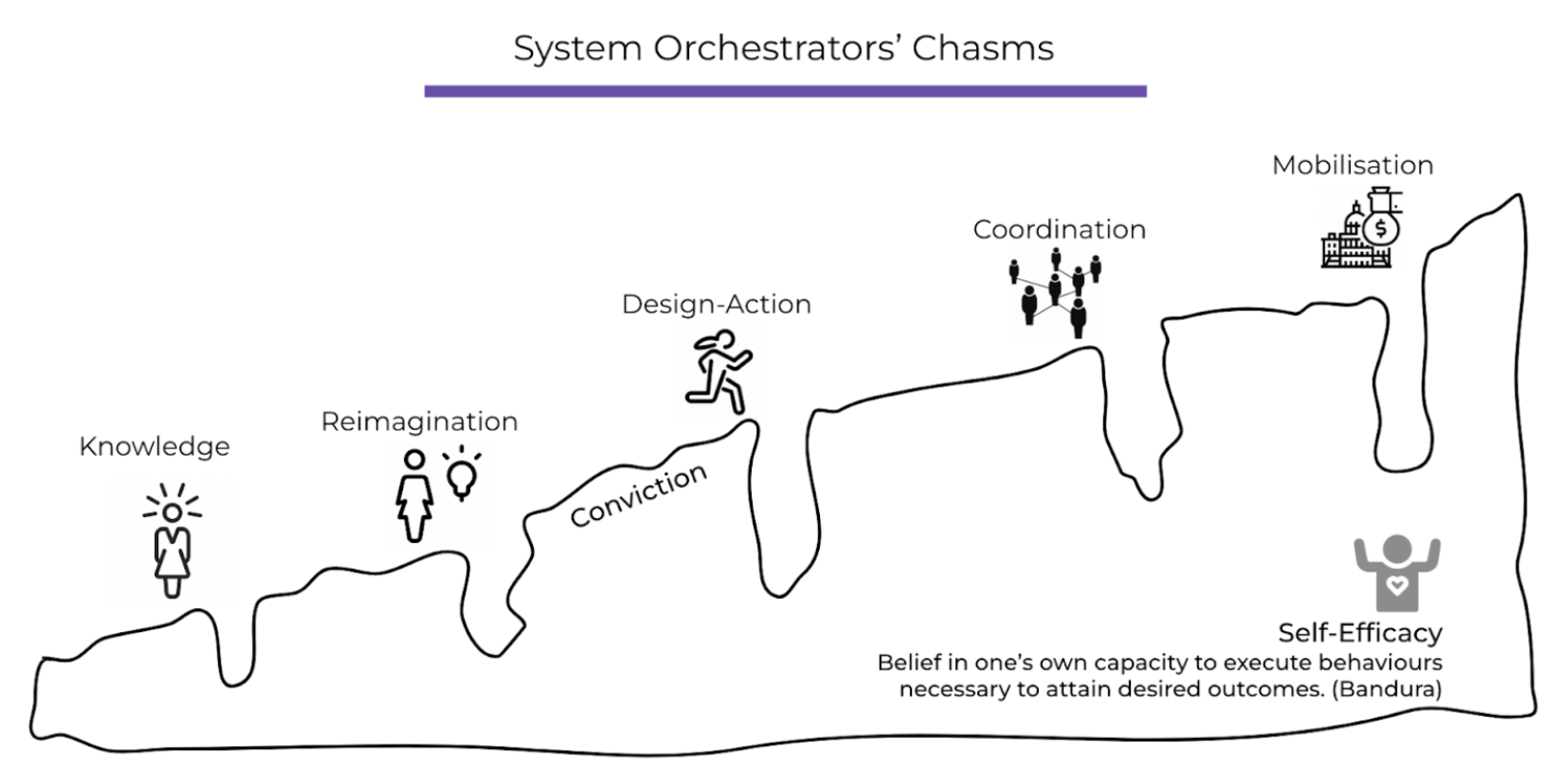
Can all of us focused on impact at scale come together as an enabling force for them? Can we ensure that knowledge is reused, reimagination is encouraged, prototyping is celebrated, and self-efficacy of leaders is reinforced? Can we join hands to catalyze positive change by accelerating the work of the social innovators who are tackling our planet’s most existential challenges, and provide a network of support for system orchestrators? That is the vision with which we are establishing the new Centre For Exponential Change.

In the Skoll community and across the network of Centre For Exponential Change, we continue to see system orchestrators emerge. Many started with social innovations they were scaling within their organizations and over time their credibility in the space led to a system orchestrator role. Other social innovators are system orchestrators from the start.

Given the scale of impact system orchestrators are helping drive, it’s hard for us to imagine a scenario in which the big, audacious goals that we have set for ourselves can be achieved without them. Yet the common theme we hear from them is that raising funds for what they do is challenging, even when most have lean budgets ($5M annually) and staff (~10 or less). Through surveying the field with Bridgespan, we’ve found that most system orchestrators have severe finance gaps, on average between half to 2x their budget, or about $2.5M. The Centre for Exponential Change is designed to build a community of enablers, including funders, for system orchestrators, so they can flourish and consistently leverage critical networks.

Nilekani Philanthropies works closely with system orchestrators, such as EkStep Foundation and many others engaged with Societal Thinking, and has experienced not only many successes but also setbacks. Some lessons from these experiences have become the guideposts for how philanthropy is practiced. One of them is that we need a new lens to reimagine the way we look at and solve social problems – going beyond plucking out the weeds, instead digging deep to the intertwined roots of a problem. This means opening up a space to reimagine the way we look at problems and our role in solving them, a space for experimentation, and a space for diverse actors across civil society, government and markets to come together to solve.

In the journey towards systemic change, the triad of Samaaj (society), Sarkaar (government), and Bazaar (market) plays a pivotal role. Through successful cross-sector collaborations, we’ve seen firsthand how the synergy between these sectors amplifies our collective impact. For instance, initiatives that bring together the grassroots innovation of Samaaj, the regulatory framework and resources of Sarkaar, and the scalability and efficiency of Bazaar demonstrate the power of united action. This collaborative ecosystem is at the heart of the mission for the Centre for Exponential Change, leveraging the unique strengths of each sector to foster exponential change.

It is with this vision that the Centre for Exponential Change is emerging as a co-creation space to bring together diverse enablers that support the journeys of system orchestrators in solving social problems faster, sooner, and at scale. Skoll Foundation and Nilekani Philanthropies are co-founding the Centre For Exponential Change along with New Profit and Instituto Beja with a shared vision and aspiration. Conceived as a global action network, the Centre for Exponential Change (C4EC) and its Global Members will offer:

  1. Exchange of open and practical knowledge on how to induce exponential change
  2. Actionable advisory for deep design and prototyping to explore new pathways
  3. Paradigm grants to unlock the imagination of validated system orchestrators
  4. Hands-on experienced mentors who can help navigate challenges with insights
  5. Spaces and communities to reinforce the self-efficacy of system orchestrators

When catalyzing positive exponential change, it’s possible to inadvertently perpetuate existing disparities in our society that harm marginalized populations. What may seem ambitious from a dominant paradigm may have hidden costs for the vulnerable, if not empathetically considered from their lived experience. With the right values, design principles and approach, social innovators can balance innovation with responsibility. Founded on core values of restoring agency, nurturing dignity, and empowering choices for traditionally marginalized and underrepresented groups, the Centre For Exponential Change will co-travel with system orchestrators to actively integrate and elevate voices from multiple axes of difference, lend fresh perspectives, surface blindspots and nourish equity.

Like the attention we pay to conserve and regenerate the systems in nature that preserve and rejuvenate our ecology, such as coral reefs and rainforests, we must pay similar attention to system orchestrators in our society that are essential for rapid progress towards a sustainable and equitable future. It is our responsibility to engage, listen, learn, and strive to improve our systems to reduce the friction these actors face and bridge the chasms they must cross. That commitment is at the heart of the Centre For Exponential Change.

We invite you to join this movement, reach out to become an active member of the emerging C4EC Global Network, extend your financial support or expertise with system orchestrators, share your journey and insights, strengthen the narrative, or collaborate on existing or new exponential change journeys. Visit us at the Centre for Exponential Change, and get involved!

 

Loksatta | शंभरीतलं शहाणपण!

भाषांतर संपदा सोवनी
आयुष्य तर जगायचंच असतं, परंतु ते आनंदी आणि ‘ग्रेसफुली’ कसं जगायचं हे प्रत्येकाच्या विवेकावर अवलंबून असतं. नुकत्याच शंभरीत पदार्पण केलेल्या दुर्गाबाई निलेकणी यांनी काळाबरोबर चालताना मायक्रोवेव्ह, झूम कॉलसारख्या अनेक आधुनिक गोष्टी तर शिकून घेतल्याच, शिवाय अत्याधुनिक अशा दीर्घायुष्यासाठीच्या संशोधनासाठीही त्या तयार झाल्या आहेत. ‘इतरांवर ओझं होणार नाही असं जगावं!’ हे त्यांचं ‘शंभरीतलं शहाणपण’ तर सगळ्यांसाठीच अनुकरणीय… सूनबाई रोहिणी निलेकणी यांच्या लेखणीतून उतरलेलं त्यांचं हे शब्दचित्र.

माझ्या सासूबाई- दुर्गाबाई निलेकणी- ‘अम्मा’ यांनी नुकतंच वयाच्या शंभराव्या वर्षात पदार्पण केलं. वयामुळे उद्भवणाऱ्या काही तक्रारी सोडल्या, तर त्या चालत्याफिरत्या आहेत. आरोग्य उत्तम आणि मन शांत. त्यांना कधीही विचारलं, ‘‘कशा आहात?’’ तर म्हणतात, ‘‘मी ठीक!’’ तर कधी हसून म्हणतात, ‘‘एकदम ठीक!’’ अगदी कधी श्वास घेताना त्रास होत असला किंवा काही दुखतखुपत असेल, तरीही त्यांचं उत्तर हेच असतं.

त्यांचं जीवन हे, ‘आयुष्य ‘ग्रेसफुली’ कसं जगावं’ याचं प्रात्यक्षिकच आहे जणू! कधी मलाच निराश वाटतं, तेव्हा मी त्यांना म्हणते, ‘‘अम्मा, तुम्ही अशा कशा आहात?’’ त्या म्हणतात, ‘‘सोप्पं आहे! मी मृत्यूची कधी फिकीर करत नाही. जगण्याचा विचार करते. आणि मी आनंदी आहे!’’ साधी, आहे त्यात सुखी राहण्याची एक संस्कृती होती (कधीच नाहीशी झालीय ती!), ती दुर्गाबाईंमध्ये पुरेपूर आहे. त्यांचे वडील- डॉ. अण्णाजी राव सिरूर. कर्नाटकातल्या धारवाडमधले ते मोठे डॉक्टर. चौदा भावंडं आणि असंख्य नातेवाईकांच्या गराड्यात अम्मा वाढल्या. कुटुंब खाऊनपिऊन सुखी असलं, तरी गाठीशी फार काही उरायचं नाही. एखादी गोष्ट वाया जाण्याची शक्यता असेल, तर मुळात ती मागून घेऊच नका, हा घरातला दंडक. धारवाडच्या घरात प्रत्येक वस्तूचा अगदी शेवटचा तुकडा, चिंधी, याचाही काही तरी उपयोग असे. आजच्या ‘यूझ अँड थ्रो’ काळात हे समजणंही अनेकांना अवघड जाईल. ‘साधी राहणी, उच्च विचारसरणी’ हा फक्त सुविचार नव्हता, लोकांच्या जगण्याचा धर्म होता तो! तसंच ‘माणुसकी’ ही पुस्तकी संकल्पना नव्हती. कुणी कधी मदतीसाठी दार ठोठावलं, तर शक्य ती मदत करायची, हे गृहीत होतं. एकदा अम्मांच्या एका पुतण्याला वैद्याकीय उपचारांसाठी पैसा लागणार होता. अम्मांनी त्यांच्याजवळचे जवळपास सगळे पैसे देऊन टाकले नि वर ‘माझी मुलं बघतायत माझ्याकडे, मग मला वेगळा पैसा कशाला हवा?’ असं म्हणून खांदे उडवले होते! आता कुणाविषयीही माणुसकीच्या आधी संशय मनात येण्याचा जमाना आहे. अगदी शेजारच्या घरात राहणाराही खूपदा अनोळखीच असतो, असा काळ. त्यात अम्मांसारखी माणसं दुर्मीळच!

१०० वर्षं. केवढे बदल पाहिलेत त्यात अम्मांनी! मानवी इतिहासातले अतिशय समृद्ध क्षण त्या जगल्यात. जागतिक महायुद्ध, स्वातंत्र्यलढा… तंत्रज्ञानात झपाट्यानं झालेले बदल, देशाची प्रगती… आर्थिक समृद्धी आणि चणचण… जवळच्यांचे मृत्यूही खूप पाहिले त्यांनी- पती मोहनराव निलेकणी आणि अम्मांची अनेक भावंडं, यांचे. सगळ्यातून त्या तरल्या. पूर्वी चुलीवर भाकरी करण्याची किंवा आप्तांना पोस्टकार्ड लिहिण्याची सवय असलेल्या अम्मा मायक्रोवेव्ह वापरताना किंवा ‘झूम’ कॉलवर बोलतानाही तितक्याच सहजतेनं ती गोष्ट करतात. ‘जुळवून घ्यायला हवं. नाही का?’ साध्या, स्पष्ट स्वरात त्या सांगतात. एका गोष्टीशी मात्र त्यांना जुळवून घेता आलं नाही- महागाई, चलनवाढ! खरं तर आता त्यांना स्वत:ला पर्स उघडण्याची वेळ येत नाही, पण कधी बोलताना रोजच्या वस्तूंच्या किमती माझ्याकडून कळल्या की त्यांच्या चेहऱ्यावर आठ्या उमटतात. म्हणतात, ‘‘गरीब लोक कसं भागवत असतील?…’’

त्यांच्या वयाचा उल्लेख झाला कीसुद्धा त्यांच्या चेहऱ्यावर असाच आश्चर्यचकित भाव असतो. ‘‘देव मला विसरलाय की काय?’’ असं मिश्कीलपणे विचारतात. मग मी म्हणते, ‘‘नव्याण्णव नॉट आऊट आहात तुम्ही. म्हणजे सेंच्युरी होणार नक्की!’’ त्यावर होकार देताना खळखळून हसतात.

१९२५ मध्ये त्यांचा जन्म झाला. तेव्हा आपल्या भारतीय उपखंडात सरासरी जीवनमान अवघं २७.६ वर्षं होतं! आज ते दुपटीपेक्षा अधिक झालंय- सरासरी ६७.२ वर्षं. म्हणजे पुढच्या काही वर्षांत देशाचं वय झपाट्यानं वाढणार. ‘इंडिया एजिंग रिपोर्ट २०२३’नुसार २०५० पर्यंत ६० वर्षं किंवा त्यावरच्या वयाच्या नागरिकांचं प्रमाण एकूण लोकसंख्येच्या २०.८ टक्के होण्याची चिन्हं आहेत. म्हणजे जवळपास ३५ कोटी लोक. अमेरिकेच्या लोकसंख्येएवढा आकडा आहे हा! २०२२ मध्ये १४.९ कोटी ज्येष्ठ नागरिकांची नोंद झाली होती- म्हणजे लोकसंख्येच्या १०.५ टक्के. याचाच अर्थ आज आपण जे देशाच्या तरुण लोकसंख्येविषयी बोलतो, ते चित्र २०५० पर्यंत जुनं होणार आहे. तेव्हा आपलं लक्ष आरोग्य, मानवकल्याण, आहे त्या मनुष्यबळाची कार्यक्षमता कशी वाढवायची? सर्व ज्येष्ठांना निवृत्तीनंतरचे फायदे, निवृत्तिवेतन देण्याचा आर्थिक भार कसा उचलायचा? यावर असेल. अनेक देशांपुढे अशीच आव्हानं असतील. म्हणजे मानवजातीला वृद्धत्वाच्या आव्हानांचा इतक्या मोठ्या प्रमाणावर प्रथमच सामना करावा लागेल.

काही अंदाजांनुसार जगात सध्या ५ लाखांच्या आसपास लोकांनी शंभरी गाठली आहे. पाश्चिमात्य देशांत दीर्घायुषी असण्याबद्दल संशोधन वेगानं सुरू आहे. अम्मांच्या अगदी विरुद्ध, सिलिकॉन व्हॅलीमधले काही कोट्याधीश दीर्घायू होण्याचं रहस्य जाणून घ्यायला उत्सुक आहेत. त्यातल्या एकानं तर मृत्यूला जीवनाचा भाग मानायलाच नकार दिलाय. त्याच्या मते मृत्यू हा कंप्युटरमध्ये एखादा ‘बग’ येतो ना, तसा मानायला हरकत नसावी! ‘मेथुसेलाह फाऊंडेशन’चं असं म्हणणं आहे की, २०३० पर्यंत वय वर्षं ९० हे वय ५० सारखं वाटावं. हा सर्व प्रयोग प्रत्यक्षात फसेल असंच अनेकांना वाटतंय, पण त्यातून डिमेन्शिया (विस्मरण) आणि वयाशी संबंधित इतर समस्यांवर काही उपाय सापडू शकेल.

अम्मासुद्धा अशा एका संशोधनाचा भाग होणार आहेत. ‘नॅशनल इन्स्टिट्युट ऑफ मेंटल हेल्थ अँड न्युरोसायन्सेस’च्या ( NIMHANS) एका प्रकल्पासाठी आपलं रक्त चाचणीला द्यायला त्या तयार झाल्यात. ज्येष्ठ नागरिकांत शरीरातल्या पेशी मरतात कशा, पुन्हा पूर्ववत कशा होतात, असा त्याचा विषय आहे. संशोधनाला उपयोग होणार असेल तर मृत्यूपश्चात देहदान करण्यासाठीही अम्मा तयारी दाखवतात.

अम्मांच्या शंभराव्या वाढदिवसाचे बेत आम्ही करत असतो. मी एकदा त्यांना विचारलं, ‘‘लोकांनी किती जगायला हवं?’’ त्या म्हणाल्या, ‘‘इतरांवर ओझं होणार नाही इतकं! पण ते आपल्या हातात नाहीये… नाही का?!’’ नुसतं एकेक वर्ष पुढे जात वय न वाढलेल्या, तर खरोखर रसरसून ते जगलेल्या शंभरीच्या व्यक्तीचे हे शब्द, किती सार्थ!

The Indian Express | Rohini Nilekani writes: Notes from our 2014 campaign for 2024

The headlines brought back sharp memories of a hot summer wind. Exactly 10 years ago, we had embarked on a grueling campaign for my husband Nandan Nilekani from Bangalore South constituency for the Lok Sabha elections of 2014.

Everyone knows how that particular movie ended, but there was so much we learnt which may be relevant for the sequel now playing out around the country. The first lesson that 900 million plus voters could acknowledge is that politics may be the world’s most difficult profession. We personally witnessed how politicians work 24/7, 365 days a year, surprisingly often without rewards, to meet voter demands. So, can we give a thumbs up to the thousands of candidates from dozens of parties, of whom only 543 will win, but who will all keep our vital electoral democracy humming?

The second issue is that too many voters, especially from the elite urban classes, still take the elections too lightly. They should not. India does not have a compulsory vote like 21 countries do. Our elections are more of a celebration of the right to vote than a cumbersome duty.

But we let ourselves down when we don’t participate in the free and fair elections India is so proud of, when we don’t vote. Sure, our elections come in the way of the precious summer holidays; sure, some of us may find our names removed from the voter list. But think hard of what would happen if a majority thought it was not worth their time to vote. What kind of country would India be?

The third, critical question is what people should expect from their candidates. Most voters may not have internalised that we will be choosing those whose main job is to minister parliament as good law makers. The media does not highlight this enough. Politicians only rarely talk about it themselves.

MPs have the representative responsibility to reflect the aspirations of their constituents, the power of the purse responsibility to approve the expenditure of

the government, and some oversight over the executive. But their main job is to participate in understanding, debating on and helping pass legislation that enables the nation to function smoothly, fairly and without conflict. In our experience of the 2014 campaign, that is not what the voters had understood or even wanted.

Walking for months through many slums, middle class neighbourhoods and fancy apartment complexes, we listened deeply to the people all day long. Some moments were particularly illuminating.

One sweltering day, in a fancy apartment complex, after my impassioned speech on how Nandan, if elected, would help drive systems reform, one man nodded wisely and said, “Wonderful. But what will he do about my crazy neighbour who feeds stray dogs at 1 am?”

In middle class neighbourhoods, people asked what we would do for street lights, or to keep their park green. In one such park, a lady probed — “You want my vote free or what? What will you give me?” When I mumbled something about a hardworking, ethical candidate, she was amused.

In slum areas, people were still desperate for basic services. “Bari neeru kodi, saaku,” they begged. If you can provide water, it is enough. Others spoke of electricity, transport, and hospitals. This was their one chance to pour out their frustrations to candidates and their crews.

Eventually, our team realised, even in a developed and educated city like Bengaluru, people want personally from their MPs what they should collectively organise for, or solicit from their corporators, local bureaucrats or MLAs. They want a direct solution to their local irritants, not abstract rewards.

None of these demands are unreasonable. Many, especially on basic services, are critical to meet. The question is, who should be fulfilling them? It cannot possibly be up to the MP, who has no authority or legally sanctioned resources apart from a meagre MPLAD scheme, to meet any of these aspirations. If he or she has to please such a voter, the winning candidate has to perform a politics of patronage and brokerage.

A modern democracy needs enlightened politicians to work with efficient bureaucrats to solve forever more complex issues. Too often, our laws and policies are signed off on without any discussion. Too often, we the people can’t see how that affects our day-to-day lives.

To take just one example, the Telecommunications Act 2023 cements the power of the government to suspend internet services. No urban voter even knows anymore how to live without the internet for more than a few hours. Do we not need our MP to intervene to ensure internet shutdowns can be ordered only in the rarest of rare circumstances?

For the nearly 2 crore new young voters, policy issues may be critical for what they care about most — the future of work. Similarly, for women enrolling in larger numbers than ever, laws and rules on safety and health, equity and access, may be even more important than immediate relief.

Good parliamentarians make good laws. Good laws make for a good society. Good laws when well implemented enrich a democracy with justice, equity, rights and protections. Good laws written today create a better future for countless generations ahead.

Our MPs need not be distracted by local issues, for which we must hold local governments accountable. Surely we can spare 543 leaders to focus on ideas that matter more than we can immediately perceive.

Ten years ago, our campaign team treaded the heated streets, canvassing for strategic votes. In a few weeks, we will ink our fingers as members of the world’s largest and proudest voting population.

We, the samaaj of India can deepen India’s democracy by electing those candidates who will design good laws to nourish us all.

The Indian Express | Rohini Nilekani writes: On Women’s Day, lessons on compassion and resilience from a 99-year-old

Durgabai Nilekani recently entered the 100th year of her life. My mother-in-law is in good health, physically active, and mentally calm. She has mild cognitive impairment and some age-related decline. But every time you ask her how she is, Amma will say, “Oh, I am fine!” On some days, she will giggle and say she is “Ekdam fine”. This is even when we can hear her wheezing, or when we know she is in pain.

It is a lifelong training on how to live gracefully. Some days, when I may be feeling depressed, I quiz her, “Amma, how are you like this?” “Simple,” she answers. “I don’t worry about death. I think about life. And I am happy.”

Durgabai epitomises the long-gone culture of a simple, content society.

Her father, Dr Annaji Rao Sirur, was a very popular medical practitioner in the university town of Dharwad in Karnataka, where Amma grew up with 14 siblings and many other relatives. While there was enough to go around, there was not much to spare. “Waste not, want not” was the axiom they grew up with, alongside the idea of moderation in all things.

And the phrase “Reduce, recycle, reuse” might well have been modelled on her. In the days when she expertly ran her household in Dharwad, every last scrap had a life extension that would be incredible to today’s use-and-throw consumers.

Simple living and high thinking were not just words but a dharma to live by. Compassion to all was not just written in the scriptures but something to practise on everyone who knocked at the mostly unlocked door.

Amma once gave away almost all her personal wealth to help a nephew who needed expensive medical treatment. “Why do I need money when my sons are looking after me?” she shrugged.

Amma now seems like a rare commodity in a world where suspicion is more common than compassion and where neighbours may themselves be strangers.

Her lifetime has coincided with the most prosperous age in human history, where more people have experienced more abundance than ever before.

She has witnessed so much change in these 100 years — from a World War and the Independence movement to rapid technological advances, and a prospering nation. She has experienced abundance and scarcity, death and loss, including that of Mohanrao Nilekani, her husband, and many siblings too. She has coped remarkably well and is as comfortable with microwaves as she used to be making jowar rotis on an open fire, and as easy with Zoom calls as she was writing postcards. “We have to adjust, is it not?” Amma will say, in her ever simple and ever direct way.

There is one thing she cannot adjust to, though. And that is inflation. While she no longer has to make her own purchases, her face crumples up when I tell her the price of everyday items. “But how do poor people manage?” she wonders, shaken.

Amma is equally shocked at how old she has become. “Has God forgotten about me?” she asks jokingly. But when I coax, “Since you are 99 not out, you may as well hit a century,” she agrees, emitting her signature rat-a-tat gunfire laugh.

In 1925, the year Durgabai was born, life expectancy in the Subcontinent was 27.6 years. Today, life expectancy in India has more than doubled to 67.2 years. Which means that the country will age rapidly over the next few decades. According to the India Ageing Report 2023 , the share of senior citizens — aged 60 years and above — will rise to 20.8 per cent of the population by 2050. That is almost 350 million people, approximately the population of the United States. It is double the 2022 demographic of 149 million elderly persons — roughly 10.5 per cent of the population.

By 2050, today’s conversation, about a young nation’s demographic dividend, will seem a distant dream. The focus will be on human health and well-being, the productivity of a shrunken workforce, and the fiscal challenge of providing retirement benefits and pensions for all.

Many countries will face similar challenges. Humanity will have to deal, for the first time ever, with issues of mass ageing. By some estimates, there are already half a million centenarians in the world today. Research on longevity has also speeded up, especially in the West. Unlike Amma, Silicon Valley billionaires seem particularly obsessed with increasing lifespans. One of them allegedly declared death to be a bug, not a feature of life! And the Methuselah Foundation wants 90 to become the new 50 by 2030. If that fanciful project fails, many hope that it will, more importantly, yield answers to the problems of dementia and other age-related disorders.

Amma may herself contribute something of significance to medical research. She has agreed to donate her blood to a project at NIMHANS, which analyses cell degeneration and rejuvenation in older people. She would surely volunteer to donate her body for research if she believed it would help others.

As we plan for her 100th birthday, I ask Amma, “How long should people live?” “So long as they are not a burden to others,” she says. “But it is not in our hands, is it?”

Wise words from a compassionate centenarian, who has gracefully added life to her years, not just years to her life.

Project Syndicate | Making Sense of Society

By Michael Spence, a Nobel laureate in economics, is Professor Emeritus of Economics and a former dean of the Graduate School of Business at Stanford University.

A 2022 book argues that the only effective responses to government or market deficiencies come from civil society. When society is “malfunctioning” – for example, owing to deep polarization or fragmentation – that response mechanism is disrupted and can even stop working altogether.

MILAN – How to strike the right balance between the state and the market, and ensure the proper functioning of both, has been debated for centuries. But Indian author and philanthropist Rohini Nilekani offers an answer that focuses on neither. As the title of her 2022 book, Samaaj, Sarkaar, Bazaar (Society, State, Markets): A Citizen-First Approach, suggests, society comes first.

For Nilekani, a stable, well-functioning, and inclusive society is essential, first, as an end in itself. But it is also crucial for another reason: a healthy civil society is a prerequisite to effective governance and beneficial market outcomes. As she explains, the state and markets carry out important functions but are vulnerable to errors, imbalances, inefficiencies, and failures, such as capture by special interests. This can result in myriad problems, from rising inequality to shortfalls in the provision of public goods.

That is where society comes in. According to Nilekani, the only effective responses to government or market deficiencies come from civil society, including the values, relationships, and organizations that underpin it. When society is “malfunctioning” – for example, owing to deep polarization or fragmentation – that response mechanism is disrupted, and can even stop working altogether.

Nilekani’s argument evokes insights from two other thinkers: the economist Albert O. Hirschman and the political scientist Robert D. Putnam. Hirschman’s influential 1970 book Exit, Voice, and Loyalty: Responses to Decline in Firms, Organizations, and States argued that actors express their dissatisfaction with underperformance in two main ways. They can “exit” (in favor of an alternative) or use their “voice” to apply pressure for change (such as by highlighting their concerns, proposing solutions, or even threatening to take action that would undermine performance further).

But while it is probably relatively easy to “exit” a firm that is not meeting one’s needs as a consumer – especially if alternatives are readily available – exiting a country is not always a realistic or attractive option, nor equally available to all. More affluent or educated citizens generally have an easier time leaving their country and entering another. People without such advantages might also try to exit a bad situation, but it is likely to be much more difficult; in certain cases, they might even have to risk their lives.

This might help to explain Nilekani’s focus on the fine detail of the institutions whereby civil society exercises its influence over the state and markets. In her view, one can assume, voice is a more powerful, effective, and broadly accessible response to organizational underperformance than exit.

Likewise, Putnam focuses on civil society and community in America. In Bowling Alone: The Collapse and Revival of American Community and The Upswing: How America Came Together a Century Ago and How We Can Do It Again, he analyzes the multidimensional decline of community in the United States, providing a detailed account of the deterioration of civil-society institutions in the Gilded Age (from the late 1800s to the early 1900s), their reconstruction in the interwar period, and their decline again 2-3 decades after World War II. These institutions, Putnam argues, must be built from the ground up yet again.

Despite their differences, Nilekani, Hirschman, and Putnam all seem to share the belief that a healthy and cohesive civil society, supported by effective institutions, is a prerequisite for effective governance, market regulation, and necessary reforms to the state and the economy. For this mechanism to produce truly effective governance, however, citizens must also understand their own civic responsibility, as well as what it takes for the state (or other organizations) to deliver on their priorities. And, as Nilekani’s work shows, this is far from guaranteed.

When Nilekani surveyed Indian voters about what they wanted from their elected representatives, their responses always focused on local-level outcomes, especially with regard to reform and service delivery. Not one person mentioned anything about legislation. But well-crafted, forward-thinking legislation is essential to promote the kind of long-term inclusive growth that benefits all citizens.

Indians, in particular, should recognize this. India’s activist Supreme Court has used its authority to enforce citizens’ rights to advance consequential environmental and other reforms. Moreover, its public sector has created what many (including me) regard as the world’s best digital financial architecture, comprising a biometric identification system and a “unified payments interface,” administered by the National Payments Corporation of India.

This architecture – accessible to all citizens – enables not only instant payments, but also direct financial transfers from the government to poorer segments of the population in real time with no intermediaries and thus no “leakage.” It also provides for data mobility across multiple entities, from banks to digital wallets. This process is guided by legislation dictating that all data flows require permission from individuals who are the subjects of the data. Once permission is given, all data must flow, by law, directly from their location to their intended destination. This explains why there are no significant monopolies in India based on control over data.

The lesson is that laws and regulatory structures are critical to state activities that produce local-level benefits. If citizens are to push for reforms and interventions that increase efficiency, promote inclusion, and enable entrepreneurship, innovation, and long-term growth, they need to recognize this. The kind of effective civil society Nilekani envisions thus requires civic engagement, empowerment, and education, including an understanding of the rights and responsibilities implied by citizenship.

In a world that is becoming fragmented within and across countries, it is easy to lose hope for social and economic progress. Nilekani does not, and her thoughtful, realistic, and cautiously optimistic blueprint for a healthy society is worthy of attention, reflection, and debate.

The EdelGive Hurun India Philanthropy List 2023

Rohini Nilekani, Chairperson – Rohini Nilekani Philanthropies, has been named the ‘most generous woman philanthropist’ for the fourth consecutive year, according to The EdelGive Hurun India Philanthropy List 2023. She donated Rs 170 crore in FY23, finding a place both in the top 10 philanthropists in terms of overall giving, as well as the top 10 philanthropists donating entirely out of their personal wealth.

Alliance Mag | The Trust Imperative: Reshaping Society’s Participation in Systems Change

I was walking with a young leader of an Indian civic engagement organisation last week, when he shared a perspective that stayed with me. He said, “Sometimes, society believes its role is solely to resist deep-rooted power structures. But what if we, as citizens, fundamentally reconstructed these power structures?”

The triad of markets, states, and society often determines change in the world. Society can highlight problems in holding power accountable, an increasingly complex role in today’s polarised world. However, these approaches are intertwined. They are two sides of the same coin, underpinned by the drive for change and societal betterment.

An example of such change is the Akshara Foundation’s Ganitha Kalika Andolana program. This education initiative in Karnataka, India, actively involves the community in the learning process and has bridged the gap between schools and their communities, fostering mutual development and responsibility. Centered around math contests, this initiative sparked excitement throughout various public spaces – schools, community buildings, and temples. However, the initiative’s reach extended far beyond the students — the program aimed to involve parents, heightening their awareness of their children’s numerical abilities.

Along with student participation, the community’s involvement, reflected in the local contributions of resources and donations, was a crucial part of the program’s achievement. By facilitating a unique connection between schools and communities, the Akshara Foundation’s Ganitha Kalika Andolana program reframed the ‘us versus them’ paradigm, creating an interconnected, mutually beneficial network of stakeholders who are united in enhancing educational outcomes.

The Kshetra Foundation for Dialogue also exemplifies this approach through its construction of ‘dialogic spaces.’ They use the Dialogic Method to support individuals, organisations, and communities to deal with conflict, create spaces for dialogue, and build cultures and systems that foster dialogue as a default way of doing things. The true power of these spaces lies in the attitudinal shifts they engender. Individuals leave these spaces with a sense of trust, new perspectives and insights that foster systemic change over time.

Another initiative, Reap Benefit, based in Bangalore, India, employs this unique method. Reap Benefit primarily aims to build civic muscle in young people to solve local issues through their network of ‘Solve Ninjas’. A tool called ‘Samaja’ further enhances this initiative. It empowers any young person or community to leverage technology in resolving their local problems. Reap Benefit’s goal is not to expand its own organisation, but to ignite a movement that enables communities to become problem solvers.

The imperative of trust reshapes societal engagement in systems change. It serves as both glue and lubricant in the social change machinery, promoting cohesion and facilitating dynamic transitions in an ever-changing world.

A prime example is Prasanna, an 8th grader who noticed the absence of a suitable place to read in his village. Through his efforts, he successfully advocated restoring an unused library. His journey from being a Solve Ninja to a civic leader embodies the transformational power of engagement.

While these examples demonstrate positive engagement, resistance still serves as a necessary check on power. However, when resistance becomes the default mode of engagement, it can inadvertently reinforce narratives of antagonism, potentially eroding the fragile ecosystems of trust vital to a thriving society.

Trust-based philanthropy acts as a catalyst, embedding trust, intentionality, and transparency in relationships with Civil Society Organizations (CSOs). This foundational trust significantly influences the community’s broader interactions and relationships, fostering openness and commitment to shared values between CSOs and communities.

Rather than simply recipients, CSOs are transformed into carriers and multipliers of trust. By ‘paying forward’ the trust received from philanthropists, CSOs create a ripple effect of trust and collaboration throughout the civic network. This trust fortifies each interaction, contributing to a resilient civic engagement framework capable of navigating social complexities with cooperation and mutual respect. In turn, trust-based philanthropy becomes pivotal in transforming civil society’s engagement strategies and championing collaborative approaches to social change.

The imperative of trust reshapes societal engagement in systems change. It serves as both glue and lubricant in the social change machinery, promoting cohesion and facilitating dynamic transitions in an ever-changing world. This deep infusion of trust into philanthropic efforts ensures participation extends beyond mere involvement to encompass influence and co-creation towards meaningful change. With the trust imperative active, the participation narrative shifts from token inclusion to empowered engagement, where societal actors can collaborate and influence, driving resilient systems change and embodying transformative, trust-based philanthropy.

Within our current Overton window – the range of policies and ideas considered acceptable in public discourse –  pure oppositional tactics may have limited impact. A transformation of systems through active participation may yield better results than opposition alone. Society can construct more equitable power structures aligned with our shared values by shaping narratives, building trust, and widening the Overton window from within.

Civil society’s engagement with power structures isn’t a binary choice between resistance and participation. It is a spectrum of various approaches that include these strategies, part of a broader repertoire of civic engagement, which also encompasses collaboration, negotiation, innovation, and more.

Realising a just society also necessitates systemic changes in our economic, political, and social structures. Recognising these complexities showcases our capacity for self-reflection, dedication to progress, and aspiration to contribute to an equitable society.

Trust-based philanthropy plays a significant part in this transformation. It promotes a more egalitarian, inclusive model, challenging the power imbalances of the traditional top-down approach. It recognises the need to redistribute power, reduce bureaucratic hurdles, and foster a more responsive, adaptive, and impactful philanthropic sector.

Substantial trust-based realignments in our societal structures require a change to take root within us first. This internal shift readies the ground for an external transformation, enabling society to progress from a simple overseer to an active cultivator of trust and change.

However, trust-based philanthropy doesn’t cure all. It functions within larger systems that can still perpetuate inequality and injustice. Realising a just society also necessitates systemic changes in our economic, political, and social structures. Recognising these complexities showcases our capacity for self-reflection, dedication to progress, and aspiration to contribute to an equitable society.

We have the opportunity to transform our society into one rooted in trust, shared responsibility, and mutual understanding. The path ahead is challenging, but trust offers a roadmap to walk together as we listen, understand, and build the social fabric we all depend upon. There is no more critical work than this: to realise a society rooted in trust, where responsibility is mutual and power balanced. The time for change is now.

IDR | What does the DPDP Act mean for philanthropy in India?

Written by Gautam John, CEO of Rohini Nilekani Philanthropies

The Digital Personal Data Protection (DPDP) Act of 2023 marks a significant shift in India’s legislative landscape. By establishing a comprehensive national framework for processing personal data, it replaces the previously limited data protection regime under the Information Technology Act, 2000.

The DPDP Act applies to the processing of digital personal data within India, and to data collected outside India if one is offering goods or services to Indian residents. The act encapsulates various principles of data protection, such as purpose limitation, data minimisation, storage limitation, and accountability. It also provides multiple data subject1 rights (rights of individuals whose data is being collected), including access, data correction, deletion, and grievance redressal.

Beyond its legal ramifications, however, the passage of the DPDP Act calls for a moment of introspection for the philanthropic community. The act’s emphasis on data protection and privacy rights is a timely reminder of the evolving responsibilities and challenges faced by philanthropic organisations and their grantees.

While the DPDP Act covers a broad spectrum of data concerns, this article focuses on exploring its implications on impact measurement within the philanthropic realm. As we delve into this facet, it’s worth noting that the act, like any evolving legislation, will invite further interpretations.

CSR’s focus on data-driven impact measurement

India’s CSR regulations have historically pushed companies towards a data-driven approach to demonstrate their social and environmental impact, insisting on detailed tracking of both user data and impact measurement. This is regardless of the model adopted by CSRs, that is, whether they run their own social and environmental projects or allocate grants to nonprofits to execute initiatives on their behalf.

The rigorous demand for data and impact evidence is now at odds with the stringent provisions of the DPDP Act.

For instance, if a company undertakes an education initiative directly, it might require detailed student profiles to demonstrate the tangible outcomes of its interventions. In a similar vein, nonprofits being funded by companies are often asked to furnish comprehensive reports showcasing impact—this necessitates the collection of data such as medical histories, personal narratives, or academic progress, depending on the project.

This rigorous demand for data and impact evidence (in both approaches) is now at odds with the stringent provisions of the DPDP Act, especially those pertaining to user data collection, storage, and reporting.2 Such a clash has significant implications for funders and civil society organisations that engage in impact measurement and evaluation, and raises important questions about user data collection and reporting and compliance.

What will change?

Collecting personal details without informed consent was an ethical conundrum even before the introduction of the DPDP Act.3 The act merely crystallises these ethical concerns into tangible legal mandates. For example, under Sections 3 and 4 of the new legislation, gathering intimate personal information such as health records or financial data without explicit consent could pose legal risks.

Moreover, the act’s emphasis on data security, minimisation, and explicit consent complicates the previously straightforward reporting processes integral to CSR. Complying with data security and minimisation requirements in Sections 8 and 11 may add substantial administrative burdens for resource-strapped organisations.

In addition, if nonprofits are to comply, they will be confronted with increased legal liabilities and administrative overheads. This cost is more than just financial; it takes away from resources that could be channelled into doing transformative work.

Going beyond numbers

Given the stringent requirements of the DPDP Act, there’s a pressing need for revisiting and potentially revising the CSR guidelines. Striking a balance between accountability and privacy becomes crucial in ensuring compliance with both CSR and data protection mandates.

While accountability remains paramount, it’s time to transition from rigid metrics to narratives of change. By fostering relationships built on mutual respect and shared learning, practices followed by donor organisations can resonate with the ethos of the DPDP Act and nurture a more collaborative philanthropic ecosystem.

This necessitates a fundamental rethinking of how social impact can be measured, and shifting the focus from data collection to storytelling and community empowerment. By upholding privacy and agency, as per Sections 6 and 12, the law provides an opening to develop more participatory and human-centred evaluation frameworks. Funders are pivotal in enabling this evolution by modifying expectations, building capacity, and championing new trust-based and collaborative models of assessing progress.

While the philanthropic sector, especially CSR, has traditionally leaned heavily on quantitative metrics to measure impact, it’s becoming increasingly evident that numbers alone don’t capture the full spectrum of change. Trust-based philanthropy does not seek to abandon these metrics but to complement them. It suggests that, alongside traditional measurements, there’s room for more qualitative, human-centric indicators.

Drawing from the experiences of pioneering funders and nonprofits, here are our learnings on implementing trust-based philanthropy in the context of the DPDP Act.

1. Have conversations with your grantees

Funders have an obligation to understand impact, but the understanding becomes more profound when it’s rooted in both data as well as human experiences. Strict numerical metrics sometimes miss the nuanced changes and adaptations taking place in communities.

Instead of solely focusing on end results, trust-based philanthropy encourages funders to appreciate the journey—the collaborative learning processes, the stories of resilience, and the community-led innovations that are responsible for those results. This doesn’t mean throwing away the numbers, but instead adding layers of narratives and community feedback to them.

Rooted in values such as equity, community, and opportunity, trust-based philanthropy aims to build stronger relationships with grantees, cultivate mutual learning, centre trust with nonprofits, and redistribute power in the philanthropic sector.

Funders can start by initiating conversations with grantees about their experiences and stories on the ground. Impact assessment can become a richer, more holistic process by incorporating tools such as participatory storytelling and feedback loops. The idea is to strive for a balance between quantitative outcomes and qualitative process learnings.

Trust-based philanthropy envisions a future where impact measurement is not only about hitting targets but also about understanding the depth and breadth of change—change that is driven by people and their stories, and supported by numbers, not dictated by them.

2. Streamline data demands

By streamlining data demands, trust-based philanthropy liberates grantee partners from the complexities of data management and aligns seamlessly with the DPDP Act. The implications of excessive data collection extend beyond administrative burdens. Constant monitoring can feel invasive to communities and reduce their rich life experiences to mere data points. Such scrutiny can be emotionally taxing and may alienate the very individuals we aim to uplift.

Trust-based philanthropy inherently champions data minimisation and privacy—both of which the DPDP Act emphasises—by valuing qualitative insights over exhaustive quantitative data.

From an economic perspective, trust-based philanthropy offers undeniable benefits. By minimising costs related to data collection and compliance, funds can be redirected to more impactful initiatives, optimising the societal value of every rupee invested.

A compass for CSR and philanthropy

Recent research provides mounting evidence that trust-based practices are taking hold in philanthropy. A 2023 CEP study found that more than half of the nonprofit leaders surveyed reported increased trust from funders compared to the previous year. Many nonprofits also experienced shifts towards alignment with trust-based tenets, including 48 percent seeing reduced grant restrictions, 40 percent receiving more multi-year funding, and more than 50 percent facing streamlined applications and reporting. Nonprofit leaders specifically cited unrestricted and multi-year funding as the most helpful changes. This demonstrates the growing embrace of flexibility, responsiveness, and mutual understanding.

The DPDP Act should serve as a compass for CSRs and the philanthropic community. By moderating our data demands, we uphold the privacy and agency of the people we serve and alleviate the burdens on our grantee partners.

As we stand at this crossroads, we envision a future where Indian philanthropy is celebrated for both its generosity as well as its trustworthiness. This is an opportunity to champion philanthropy that’s not just compliant with the law but also resonates with the communities

sections from the DPDP Act, 2023-digital
Source: DPDP Act

—

Footnotes:

  1. The terminology used in the DPDP Act is ‘data principal’ for the person to whom the data relates and ‘data fiduciary’ for the processor of the data. This is intended to recast the provider as the primary owner and rights holder (as the principal) and implies fiduciary duties on the data processor (to ensure that processing remains in the interest of the data principal).
  2. It should be noted that Section 7(d) of the DPDP Act allows for the processing of personal information used in reporting required by the State.
  3. The requirement of active and affirmative consent for sensitive personal data (health records and financial data) was already a feature of the IT Rules. With the DPDP Act, there has been some easing of norms—while informed consent is the norm, Section 7 allows a data fiduciary to proceed with processing personal information that the user provides voluntarily and for a specific purpose. This is in the spirit of opting out rather than in. However, providing notice and opportunity to exercise rights (access, correction, and erasure) are required even in non-consensual processing, and so there will be administrative overheads to ensure compliance.

Actizen Blog | Reclaiming Our Role as Citizens

2022 marks exactly 30 years since I started my formal journey in civic engagement. Like many journeys in the civic space, mine also began with an external catalyst. I had lost dear friends to a horrendous car accident on the Bangalore-Chennai highway, which took their unborn daughter and orphaned their three-year-old son. The unnecessary loss had a searing impact on me, perhaps because I was carrying my then-unborn daughter. Although I always had an itch to involve myself in social activism, this incident moved me enough to want to do something – anything – to improve road safety. Luckily, some like-minded citizens felt the same urge, and we jumped into the fray, rather naively but full of goodwill and energy. 

In 1992, we launched a public charitable trust called Nagarik, with the tagline ‘For Safer Roads’. This was my first experience working in a formal civil society organisation, and it was a steep learning curve to rally teams and create meaningful impact. In the end, Nagarik collapsed because we could not sustain a momentum of citizen interest and involvement. But this early failure left me with a strong understanding of what could be done better the next time. I realised that social change requires collective action, where citizens are inspired to actively become part of the solution. It was a humbling experience but a crucial one for my personal journey, aligning with the need for mutual accountability between civil society, state, and markets.

Given the complex societal problems of contemporary India, we need all three sectors -Samaaj, Sarkaar, and Bazaar, i.e. Society, State, and Markets – to work in tandem and with mutual respect, as I have highlighted in my book, Samaaj, Sarkaar, Bazaar – A Citizen-first Approach. However, many citizens do not believe in their own power. They act as innocent consumers of a sometimes-rapacious market. They believe they bear no responsibility in governance and should benefit from it without co-creating the good governance they crave. 

Through many of my field visits, I have often heard citizens complain about garbage on their streets, the rise in corruption, or the state of their neighbourhood parks and public facilities. In frustration, they say, “This is the government’s job, the municipality’s work. They just don’t do it!” There is often little self-reflection on the role of the citizen to prevent the problem from snowballing beyond the state’s capacity to resolve it. Everyone would benefit if citizens stopped littering, took collective action against bribes, or created local committees to care for parks. Citizens can participate in public consultations on draft legislation and give feedback to improve policies and laws. But they must go beyond this to invest in deeper conversations with parliamentarians and state legislators – our lawmakers. Engaging more substantively on how better laws can lead to a better society and demanding that elected representatives involve citizens more in law-making are critical. More such democratic participation is needed in shaping all policies and laws that affect people’s lives.


There is a natural limit to what the state can do. It is almost impossible for activities of the state to effectively solve the problem of the last citizen, or what we refer to as the first mile. When citizens wait for the state to solve their problems, they lose their sense of agency; they feel helpless and hopeless. There is an urgent need for a shift in our thinking. The strength of our democracy depends on an active and engaged citizenry. 


Fortunately, we have a long tradition of social movements, and even today, thousands of civil society organisations in India actively focus on inclusion and empowerment. At the same time, it is important to stress here that the work of Samaaj is not the work of a few organisations alone. While CSOs energise and enable Samaaj, ordinary people, volunteers from every nook and cranny of the country, are the real bedrock of society. 

An active Samaaj implies a civil society that is engaged and participatory. It takes on the agency and responsibility of co-creating good governance with the state and holding markets accountable to the people they serve. It also thinks aloud about how its own choices affect the planet. As I describe in my book, citizens can work together to identify issues and collaborate with local government on solutions.

We must start having conversations about how do we see ourselves as citizens first. How do we see ourselves not just as consumers or subjects of the state, but as active participants in society? We must work to make our society better for everyone, whether that means just doing something within your building, house, neighbourhood, city, or for the whole country. So, just that flip from realising you’re not a subject, you’re not a customer, you are a human being and a citizen first – once these layers are understood, it becomes easier to do the work which strengthens Samaaj.


To the young people in our country, I say (1) Cultivate empathy, (2) Stay curious, (3) Stay connected, understand all the connections, (4) Stay committed, and (5) Always participate.


All of us know things around us are not right. Some children may wonder, “Oh, why are we wasting water?” Some other young person may say, “Oh, what about our rights of expression?” Some other young people may be interested in other environmental issues. Please learn more about what you care about and are passionate about and want to change, and then think, talk to your elders, talk to your friend, “How can I participate in making real change?” Participate with humility, participate without judgment, and participate with self-reflection.

ORF | Pathways to Equality: Advancing Gender Goals in the G20

Pathways to Equality: Advancing Gender Goals in the G20 (a publication by Observer Research Foundation (ORF)) assesses a selection of critical issues faced by women in the G20 nations. It is a critical ‘thinking and doing’ volume for readers seeking to understand how we can transform society by moving the needle on gender equality. The curated essays discuss gender inequality in the G20 countries and explore current initiatives that are being taken to address this pressing issue. It features an all-star set of contributors from various fields, including eminent leaders from politics and society, philanthropists, policymakers, and thought leaders. The featured essays highlight the struggles but also offer up ideas and positive examples of how gender bias can be remedied in creative and practical ways.

A POSITIVE VISION OF MASCULINITY – ROHINI NILEKANI (this article was first published by ORF)

As early as 1995, the Beijing Declaration and Platform for Action called for a change in the partnership between men and women. This declaration was signed by India, along with 188 other countries, and much progress has been made on women’s rights since, especially when it comes to crucial indices such as enrolment and retention of girls in school, maternal health, and mortality, access to sexual and reproductive health, and financial inclusion. In India, I have witnessed the transformation among some of the 60 million women who are members of self-help groups, becoming more financially independent and sometimes emerging into local politics, as powerful influencers of public policy. This has resulted in more than one million elected women leaders at the panchayat level of government, possibly a world record. Much more remains to be done, however, when it comes to the empowerment of women, girls, and other genders. In fact, in many societies, we may be losing the gains made in the past two centuries.

This, then, is a useful moment to revisit the spirit of the Beijing Declaration. This is the time to understand the root causes of gender inequity and to pause and examine why efforts around building a gender-equitable society often omit the participation of or active engagement with boys and men, whose lives are inextricably linked to women.

The Challenge
Gender equity is as important for men and boys as for women and other genders. Inequitable gender norms lead to severe negative impacts on people of all genders. While women and transpeople face violence and discrimination, barriers to livelihoods, health services, safe public spaces, and more, rigid masculine norms can put pressure on men and boys to engage in risky behaviours such as violence, unsafe sex, and substance abuse. Men often find themselves in physically and psychologically unsafe spaces, while social norms prevent them from being vulnerable or opening up about their challenges and seeking help. As a result, many men struggle to form stable, fulfilling relationships.

My attention was drawn to the issues of men and boys about seven years ago. A few instances from that time have stayed with me. One was in Ramanagara, Karnataka, when I saw a young boy crying in a public space and stopped to ask him what had happened. He was with his sister, and he was crying because although he had done very well in his 10th standard examination and wanted to study further, his father
had just informed him that he had secured him a job in the local Skills Training Corporation and that he would have to join the government. There was no question about him studying further. I have spoken
similarly to dozens of young men who have felt forced to follow in their father’s footsteps when it came to their livelihoods.

Another incident was when our car was stopped on a busy highway by a group of young men wielding lathis (sticks). They were holding up traffic in frustration at a local deadly accident, but their faces were flushed with excitement and a sense of raw power. The youngest among them could not have been more than 10 or 11 years old. And there were no girls or women in that mob.

The last example is of the scene at an employment queue, where dozens of young men were waiting, praying for jobs. These were posts like security guards, sales and service agents, or others that would barely offer subsistence wages. In their eyes, I could see equal parts of hope and despair. These snapshots assemble like a gallery for me, portraying the reality faced by 200 million young men in India, between the ages of 13-25, many of whom lack adequate opportunity, employment, and dignity.

This led me to investigate which organisations are working on these issues. There were not too many when I opened up a philanthropy portfolio to work with and for young men and boys. Today, my foundation has 16 partner organisations trying innovative ways to create shared and safe places for young males who aspire to become their best selves.

In multiple accounts from our NGO partners, and through our own research, we have heard boys talk about their worries, and rue the lack of intimacy or spaces where they can be real and vulnerable. In focus group discussions with boys in the 18-to-22-year age bracket across social classes, some said that many ideas of boyhood and manhood are forced upon them—they have to be strong, breadwinners, successful, protect and bring honour to their families, and uphold the traditions of society (1). They have to become worthy of marrying a girl by accumulating higher educational qualifications and high-paying jobs, and always doing better than their fathers.

But millions of young men simply cannot live up to these expectations. We see this even on a global scale, with the International Labour Organization calling the young men of today a scarred generation (2). Too many of them are undereducated, underemployed, and unemployable because they lack the new skills valued by the current economy, as traditional livelihoods like farming have lost their appeal. These are challenges that men face in ways unique only to them, but as Richard Reeves says, we often mistake the problem of boys and men with the problem with boys and men.

When we look at the lives of men and boys through the lens of data, the statistics are grim. In India, for instance, in 2021, 81 percent of all recorded accidental deaths were men; 73 percent of all suicides were
male (and these numbers have jumped by an average of 25 percent since 1967) (3); 96 percent of all persons in prison are men (4); and an overwhelming majority of alcohol users are males (about 95 percent) who fall in the age bracket of 18-49 years (74 percent) (5). Anecdotally, substance abuse among boys is on the rise, with the age of initiation getting lower and lower. In education, the latest Unified District Information System for Education data shows that more than 18 percent
of districts in India are reporting higher school dropout rates for boys (as compared with girls) (6). Moreover, data reports boys having higher rates of extreme stunting and wasting in comparison with girls (7).

The argument here is not that girls and women face no challenges, or that the lives of boys are worse than that of other genders. The point of presenting data about the lives of boys and men is that raising boys in a patriarchal mould is not only serving the world badly but is also coming at a high cost to them. This is something we must take a closer look at, especially because the world is changing rapidly, and society is in a period of great transition.

The Role of Boys and Men in Shifting Social Norms
This is a time for new openings, but also tremendous anxieties. Boys and men increasingly feel they have no control over their future. They are having to deal with elements in the marketplace that they have not been raised to understand—including women, technology, and climate change. At the same time, there is a lack of positive/alternative role models for many boys. How often do boys see fathers taking on household work or being the primary caregivers? Not only do social norms disallow men from stepping up to these roles, but the structural economy also prevents it. In India, fathers are entitled to only 15 days of paternity leave, compared with 26 weeks for the mother. This is even though studies show that paternity leave not only pushes fathers to assume greater parental responsibilities but also fosters better relations with and growth of the child, to say nothing of being a huge support to the new
mother (8).

Without adequate structural support, the burden of livelihoods will continue to fall on men, which will in turn keep women locked in traditional caregiving roles. The falling rate of women’s labour participation in
India may be a wake-up call. Perhaps it is time to see gender equity as a household-level issue, where women are freed from the home so they can break ground in traditionally male-occupied spaces, and men are encouraged (and sometimes they even need permission to be so, as our informal research has shown) to be active householders. Certainly, an efficient, demand-led system of childcare, provided by both the sarkaar (state) and the bazaar (market) could be a key driver of change in the samaaj (society).

Without such interventions, boys are set up to continue reinforcing the archetypal macho image and pretend that everything is fine, even when it is not. When there are millions of young people who feel this way in any nation or society, it results in these young and restless men turning inwards or outwards, possibly in violence. Recent events in India and worldwide confirm that there is indeed a backlash from increasingly insecure males of all political and religious hues. It is prudent for all of us, especially academics, policymakers, and practitioners, to pay keen attention to why that is happening, and design a non-judgemental, highly creative response to this emergence, not just in programmatic work, but within each one of us, in our homes, social groups, and in the broader polity.

A Call for Public Programmes for Boys and Men
How can we better support boys and men looking for change? Civil society organisations are natural allies for this work, but public programmes can catalyse this work at scale. In our internally commissioned research, we found that in 2021, ~US$365 million was allocated in the national budget for schemes and programmes for girls (for example, girls hostel scheme, Mission Poshan, and Mission Shakti) but no separate funding was allocated for programmes looking to intentionally engage males. In 2014, US$3 million was allocated towards a scheme called Saksham (holistic development of adolescent boys); however, no funds were released, and the scheme was shelved.

As we continue to work for women’s empowerment, can we also creatively solve this challenge of young men’s empowerment? Can we design public programmes for young males? Can we innovate safe, shared spaces so that boys can talk to each other without ridicule and fear? Can we imagine social structures where young men can organise around financial and other needs? Can we make time for boys to learn
about arts, sports, painting, and music, and encourage them to pursue things that help them grow as human beings?

We need to open up these conversations in our own homes, at the dinner table, or when families spend time together. We need to especially have these conversations in rooms where many men and women come from a place of privilege. While we continue to run gender sensitisation programmes on the field, in villages, and places where boys and men sit at the intersection of many disadvantages, it is equally necessary to keep one channel open with powerful privileged men. How do men who are rich, successful, and powerful participate in the creation of a society they want for their daughters and sons? What kind of role models can they be for the next generation? How can business owners thread care
and gender equity into all aspects of their factories and businesses?

This is a creative challenge for the corporate sector, which has done some credible work on empowering women at work. Now there is more work to do with men. I have met so many young men who want to enter the social sector or the corporate sector to change the way capitalism works. They could be great leaders for this societal mission.

Through my philanthropy, I support many wonderful organisations that are at the forefront of this complex work. And through them, I am learning that the discourse is indeed shifting (9). The younger generation is increasingly questioning fixed gender norms, and their conversation is platforming plurality and fluidity. Tens of millions of young men are moving onwards and outwards from where they were born or where they were stuck, to try and make something more of themselves. But they need society’s help.

Even if they have been brought up with certain traditional values, they are open to new norms, especially on gender issues, and like young people everywhere, they are experimenting. As the saying goes, the future is here, it is just not evenly distributed. If we support them, we can make it happen sooner than we think. Moreover, green shoots are already emerging. Think of the small but noteworthy examples of single fathers, who are adopting children despite the difficulty the law presents them with. Think of the men entering unusual occupations in the arts or in the care economy.


And then there are the celebrities. Cricketer Virat Kohli missed three out of four test matches that were part of an important Australian tour to be with his newborn baby. He had to brave much controversy when he talked about this. Tennis players Roger Federer and Rafael Nadal cried openly in defiance of the norm as Federer retired from an illustrious career. More and more famous and powerful men are showing younger boys that masculinity need not be a prescripted idea.

We know that there are many such good men in the world, who have silently worked on themselves and with the women in their lives to balance power better. Again, in the spirit of inclusion, of not generalising, of not lumping men together, let us acknowledge, celebrate, and ally and work with the men who are on this journey. This must be a co-powered journey for a more humane society.

Endnotes
(1) Rohini Nilekani, Report: What’s It like Being a Young Man in Urban India Today?
(Bangalore: Rohini Nilekani Philanthropies Foundation, 2022), https://
rohininilekaniphilanthropies.org/resources/report-whats-it-like-being-a-youngman-in-urban-india-today/
(2) International Labour Organization, Global Employment Trends for Youth: 2011 Update,
October 2011 (Geneva: International Labour Organization, 2011), https://www.ilo.
org/empelm/pubs/WCMS_165455/lang–en/index.htm
(3) NCRB, Accidental Deaths and Suicides in India 2021 (New Delhi: NCRB, 2021), https://
ncrb.gov.in/sites/default/files/ADSI-2021/ADSI_2021_FULL_REPORT.pdf
(4) NCRB, Prison Statistics India 2021 – Executive Summary (New Delhi: NCRB, 2021),
https://ncrb.gov.in/sites/default/files/PSI-2021/Executive_ncrb_Summary-2021.
pdf
(5) National Drug Dependence Treatment Centre and All India Institute of Medical
Sciences, Magnitude of Substance Use in India 2019 (New Delhi: Ministry of Social
Justice and Empowerment, 2019), https://socialjustice.gov.in/writereaddata/
UploadFile/Survey%20Report636935330086452652.pdf
(6) Ministry of Education, Unified District Information System for Education Plus: 2021-2022
Flash Statistics (Ministry of Education, 2022), https://www.education.gov.in/sites/
upload_files/mhrd/files/statistics-new/udise_21_22.pdf
(7) Kundan Pandey, “Why are Boys More Malnourished than Girls in India?,”
DownToEarth, February 19, 2018, https://www.downtoearth.org.in/blog/health/
why-are-boys-more-malnourished-than-girls-in-india-59734
(8) Richard J. Petts et al., “Fathers’ Paternity Leave-Taking and Children’s Perceptions
of Father-Child Relationships in the United States,” National Library of Medicine,
2020, https://www.ncbi.nlm.nih.gov/pmc/articles/PMC7030161/
(9) Rohini Nilekani, “Build the Field. Build the Movement. Engaging Young Men
& Boys in India,” Rohini Nilekani Philanthropies Foundation, 2021, https://
rohininilekaniphilanthropies.org/resources/report-build-the-field-build-themovement-engaging-young-men-boys-in-india/